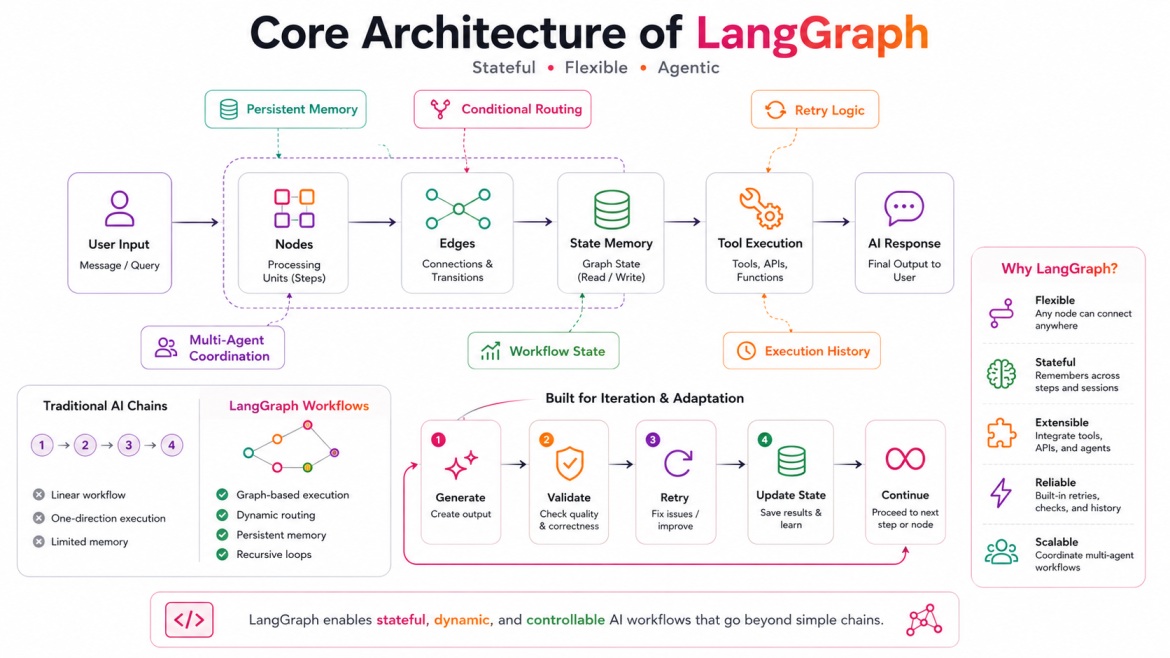
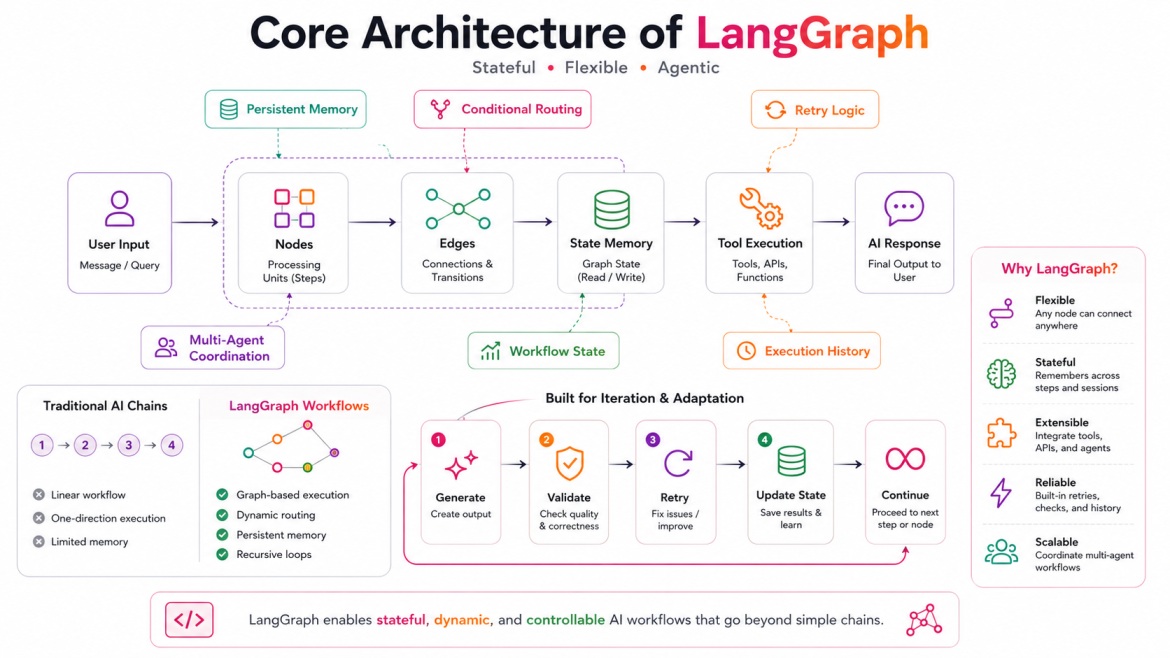
LangGraph is an open-source orchestration framework built on top of LangChain for creating advanced, stateful AI agent workflows. It helps developers build systems that can reason, maintain memory, coordinate tools, and execute multi-step tasks dynamically. Unlike traditional linear AI pipelines, LangGraph models workflows as graph-based structures using nodes and edges. This architecture supports conditional routing, feedback loops, parallel execution, and multi-agent orchestration for production-grade AI systems. In this blog, you will explore how LangGraph helps build scalable, stateful, and production-ready multi-agent AI systems using advanced workflow orchestration and memory-driven execution. Understanding the Core Architecture of LangGraph At its core, LangGraph replaces traditional linear AI chains with graph-based workflow execution. Instead of forcing AI systems to move step by step in a fixed order, LangGraph allows workflows to behave more dynamically using connected nodes, memory, and conditional routing. You can think of it like a smart flowchart for AI agents where the system can revisit previous steps, retry failed actions, remember earlier decisions, and adapt during execution. This architecture allows AI systems to: · Maintain long-running memory · Return to previous workflow states · Route dynamically between tasks · Recover from failed actions · Coordinate multiple AI agents · Execute tasks asynchronously Because of this flexibility, LangGraph is becoming increasingly important for advanced agentic AI systems and production-level workflow automation. Graph-Based Execution Model LangGraph organizes workflows using connected execution components where each part of the graph performs a specific responsibility. Component Function Nodes Execute tasks or reasoning steps Edges Define workflow transitions State Stores workflow memory and context Executors Manage graph execution Reducers Merge state updates Memory Layers Preserve execution history Unlike traditional AI chains that move only forward, LangGraph supports dynamic workflow execution. This means workflows can: · Repeat steps automatically · Pause for human approval · Retry failed operations · Switch between different paths · Coordinate smaller sub-workflows For example, an AI coding assistant may generate code, run tests, detect errors, retry fixes, and continue execution until the output works correctly. Stateful Workflow Design One of the most important features of LangGraph is persistent state management. In standard LLM workflows, memory is usually temporary and limited to the active conversation. LangGraph extends this by allowing workflows to maintain structured memory across multiple execution steps. Typical workflow state may include: state = { "user_query": "...", "retrieved_documents": [], "tool_outputs": {}, "execution_history": [], "agent_decisions": [] } This state object acts like the memory system for the workflow. For example, a research agent can remember: · Previous searches · Retrieved documents · Failed attempts · Tool responses · Earlier decisions This allows AI agents to maintain continuity during long-running tasks instead of starting from scratch every time. Deterministic vs Non-Deterministic Execution Modern AI systems are naturally non-deterministic, which means the same prompt can sometimes generate different outputs. This happens because large language models predict responses probabilistically instead of following fixed rules. LangGraph helps manage this challenge by separating: · Predictable workflow logic · Variable AI model responses In simple terms: · The workflow structure remains stable · The AI-generated content may vary slightly This separation makes systems easier to: · Monitor · Debug · Reproduce · Test · Manage in production environments For enterprise AI systems, this is extremely important because workflows must remain reliable even when AI-generated outputs change dynamically. LangGraph Workflow Patterns As AI systems become more autonomous, workflows require more advanced execution strategies than simple request-response pipelines. Modern AI agents often need to: · Retry failed actions · Coordinate multiple tools · Maintain memory · Handle branching decisions · Pause for approvals · React to external events 1. Cyclic Reasoning Loops One major advantage of LangGraph is cyclical execution. Instead of stopping after one response, workflows can repeatedly retry tasks until the result improves. Example workflow: 1. Generate answer 2. Validate output 3. Detect errors 4. Retry reasoning 5. Update memory 6. Continue execution This creates self-correcting AI behavior. For example, an autonomous coding agent may repeatedly: · Generate code · Run tests · Detect failures · Retry fixes until the final output works correctly. Traditional linear AI chains struggle to support this kind of recursive execution. 2. Human-in-the-Loop Workflows Many enterprise AI systems cannot operate fully autonomously. Some actions still require human review before execution. LangGraph supports interruptible workflows where execution pauses temporarily until a human approves the next step. Common use cases include: · Financial approvals · Legal document review · Security verification · Medical decision support For example, an AI finance assistant may prepare a payment workflow but wait for human approval before processing large transactions. This workflow pattern improves: · Operational safety · Governance · Compliance · Human oversight 3. Multi-Agent Coordination Modern AI systems increasingly use multiple specialized agents working together inside a shared workflow. Instead of one large AI agent handling everything, different agents focus on separate responsibilities. Example architecture: Agent Responsibility Research Agent Information retrieval Planning Agent Task decomposition Execution Agent Tool interaction Validation Agent Output verification LangGraph manages communication, workflow routing, and shared memory across these agents. For example, a business intelligence system may use: · one agent for collecting data · another for analytics · another for visualization · another for reporting This specialized architecture often produces more accurate and scalable AI systems. 4. Event-Driven Orchestration LangGraph workflows can also react automatically to external events instead of relying only on user prompts. Examples include: · API responses · Database updates · User activity · Real-time monitoring alerts This enables reactive AI systems capable of operating continuously in production environments. For example, a monitoring agent may automatically trigger investigations when unusual server activity or cybersecurity threats are detected. Memory Management and State Persistence in LangGraph Most standard LLM systems struggle with short-term conversational memory limitations. They often lose context after the conversation window becomes too large or when workflows become complex. LangGraph solves this problem by introducing persistent state management across workflows and execution lifecycles. This allows AI systems to: · Remember previous actions · Store workflow history · Track decisions over time · Maintain long-running context · Coordinate multiple agents consistently Types of Memory in LangGraph Different workflows require different types of memory. LangGraph supports multiple memory layers depending on the complexity of the AI system. Memory Type Purpose Short-Term Memory Stores active workflow context Long-Term Memory Preserves historical interactions Episodic Memory Tracks event-specific actions Semantic Memory Stores structured knowledge and concepts These memory layers help AI agents maintain continuity during execution instead of repeatedly starting from scratch. For example: · Short-term memory may store the current conversation · Long-term memory may remember previous customer interactions · Episodic memory may track specific workflow events · Semantic memory may retain business knowledge or facts Checkpointing and Recovery LangGraph supports execution checkpointing, which allows workflows to save progress during execution and resume later if something breaks. Instead of restarting the entire workflow, the system can continue from the last successful checkpoint. Benefits include: · Fault tolerance · Workflow recovery · Persistent orchestration · Long-running task support For example, a research agent analyzing hundreds of documents may pause temporarily because of an API timeout and continue later without losing progress. Shared State Coordination In multi-agent environments, several AI agents may work together inside the same workflow. For example: · One agent retrieves information · Another analyzes data · Another validates outputs · Another generates reports All these agents may need access to shared workflow memory simultaneously. LangGraph helps manage: · State synchronization · Concurrent updates · Conflict resolution · Shared execution context This coordination layer ensures agents stay aligned while working collaboratively inside complex workflows. Memory Compression and Context Optimization Large language models have limited context windows, which means they cannot process unlimited amounts of information at once. To solve this problem, advanced LangGraph systems often use memory optimization techniques such as: · Context pruning · Retrieval augmentation · Memory summarization · State compression These techniques help reduce unnecessary information while preserving the most important workflow context. For example, instead of storing an entire conversation history, the system may generate summarized memory states containing only key decisions and important events. LangGraph vs Other Agent Frameworks The agentic AI ecosystem now includes several frameworks designed for AI orchestration, multi-agent systems, workflow automation, and autonomous execution. However, LangGraph is mainly designed for advanced orchestration, stateful execution, and graph-based workflow management. Framework Main Focus LangGraph Stateful orchestration and graph workflows CrewAI Multi-agent collaboration AutoGen Conversational AI agents LangChain AI chaining workflows Semantic Kernel Enterprise AI integration For example: · CrewAI is useful for role-based multi-agent collaboration · AutoGen focuses heavily on conversational interactions between agents · LangChain works well for sequential AI pipelines and tool chaining · Semantic Kernel is commonly used for enterprise AI integrations within larger software systems LangGraph stands out because of its graph execution architecture and advanced workflow control mechanisms. Benefits and Challenges of LangGraph Like any advanced orchestration framework, LangGraph introduces both major strengths and engineering complexity. Aspect Strength Challenge Workflow Flexibility Dynamic execution Higher system complexity Memory Management Persistent state Memory scaling challenges Multi-Agent Support Strong coordination Concurrent state handling Reliability Retry and recovery support Debugging distributed workflows Enterprise Readiness Production orchestration Infrastructure overhead Despite these challenges, LangGraph is becoming foundational for scalable agentic AI systems. Conclusion LangGraph represents a major shift from linear AI chains toward stateful, graph-oriented orchestration for autonomous AI systems. Its support for persistent memory, cyclical execution, multi-agent coordination, and workflow recovery makes it highly suitable for advanced production-grade AI infrastructure. As agentic AI continues maturing, LangGraph is positioned to become one of the core orchestration layers powering next-generation intelligent systems.